
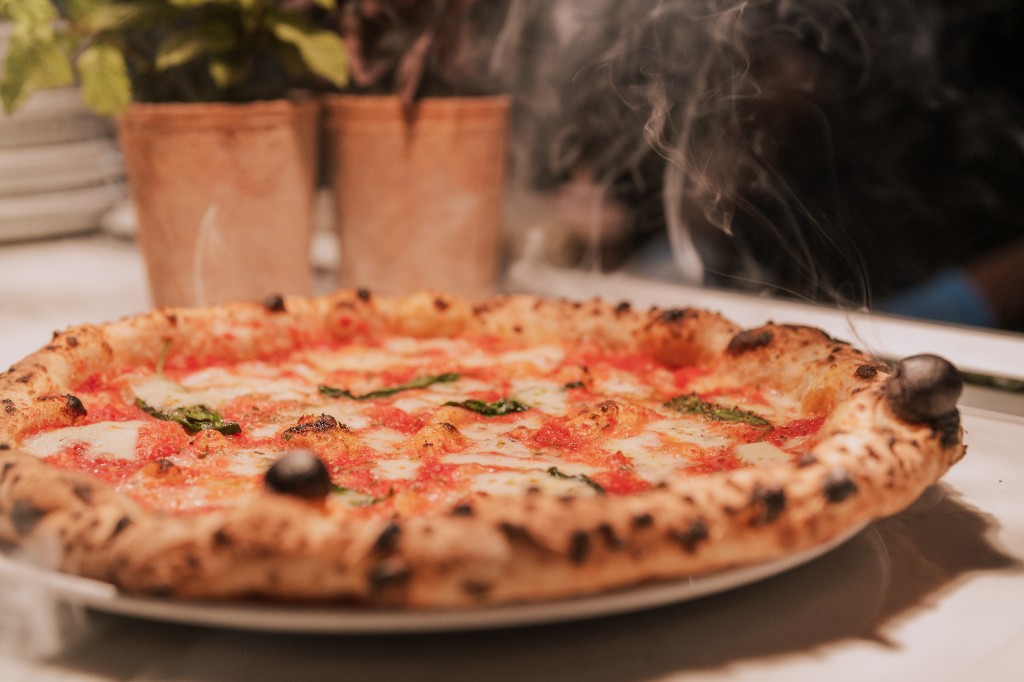
Neapolitan pizza is a soft, thin-centred pizza from Naples, prepared with slow-fermented, hand-stretched dough, San Marzano tomatoes and fior di latte, before being baked in a wood-fired oven at around 450°C for just 60 to 90 seconds. The result? A light, chewy base with a puffy, blistered edge, quite unlike the crisp, heavily topped pizzas most of us grew up eating.
If there’s anyone qualified to tell you all about this, it’s probably us. Wood Fire Smoke is an independent family business that’s been bringing an authentic slice of Naples to Cheshire since our Wilmslow restaurant opened back in 2017. We’ve since added a further three neighbourhood pizzerias in Macclesfield, Congleton and Sale, where we’re busy stretching dough, feeding wood-fire ovens and answering the same question from curious customers: what exactly makes a pizza Neapolitan?
This guide leaves no stone unturned, covering the dough, the ingredients, the oven, the rules from Naples, how Neapolitan compares with other styles, and how to spot the real thing. And if you want to dive a little deeper, check out our wider Neapolitan pizza guide.
Where does Neapolitan pizza come from?
Pizza as we know it was born in Naples, southern Italy. Flatbreads with toppings had been eaten at tables around the Mediterranean for centuries, but it was the local bakers and street vendors who turned them into something we recognise today: a round dough base topped with tomato, baked quickly in a piping hot oven and eaten straight away.
The best-known story is that of the Margherita, said to have been named in the late 1800s after Queen Margherita of Savoy. Its red tomato, white mozzarella and green basil is symbolic of the Italian flag. Whether or not every detail is true, the Margherita is still the purest test of any Neapolitan pizzeria.
What matters most is that Neapolitan pizza is defined by its method, not its toppings. You can pretty much put anything on it. What you can’t change is how the dough is made, how it is shaped and how it is cooked. The craft of the Neapolitan pizza maker (the pizzaiuolo) is even recognised by UNESCO as part of the world’s cultural heritage.
What makes a pizza Neapolitan?
This one’s simple. Four things qualify a pizza as Neapolitan: the dough, the ingredients, the oven and the end result. Get all four right, and you have a Neapolitan pizza. Miss one, and you don’t!
The dough
Everything starts with the dough. Traditional Neapolitan dough is made from just flour, water, salt and yeast, so the magic lies in time and handling rather than a long list of ingredients.
Ours is a 36-to-48-hour slow-fermented dough. During that long, cool rest, the yeast works slowly, building flavour and creating the air pockets that make the crust light and open. A short, fast rise gives you a dense, bready base. A long, slow one gives you a base that’s soft and rich in flavour.
Our blend includes tipo 00 and tipo 1 flour, the classic choice for Neapolitan pizza. “00” refers to how finely the flour is milled, and it gives a soft, stretchy dough. You can read more in our guide to 00 flour and 48-hour dough.
Then there’s the shaping. A Neapolitan base is always hand-stretched, so you’ll never catch us with a rolling pin in-hand. Pressing the dough out by hand pushes the air towards the edge instead of squashing it out completely, which is how you get that puffy rim. A rolling pin flattens everything, including the pizza’s character.
The ingredients
Neapolitan pizza is simple, so every ingredient has to earn its place. The Neapolitan essentials are San Marzano tomatoes, fior di latte, hand-stretched dough and a bake of around 60 to 90 seconds.
San Marzano tomatoes are a variety of plum tomato grown in the volcanic soil near Mount Vesuvius. They’re sweet, low in acidity and have fewer seeds than standard tomatoes, which makes them ideal for pizza sauce. In our restaurants, the tomatoes go on uncooked. The oven does all the cooking in seconds, keeping the sauce bright and fresh. We take a closer look at this in our guide to San Marzano tomatoes.
Fior di latte is a fresh mozzarella made from cow’s milk. It melts into soft, creamy pools rather than the stretchy, oily blanket you get from the drier mozzarella sold for cooking. It’s our standard cheese, and you can see how it compares with buffalo mozzarella, burrata and others in our Italian pizza cheeses article.
Finish it off with fresh basil and a drizzle of olive oil and you have a Margherita, the pizza every Neapolitan pizzeria is judged on.
From there, toppings can be as bold as you like. One of our favourites is nduja, a soft, spicy Calabrian sausage that melts into the sauce in the heat of the oven. You’ll find it on our Calabria pizza, alongside spianata salami. Here’s more on what nduja is and how hot it gets.
The oven
A Neapolitan pizza is cooked in a wood-fired oven at around 450°C, and it takes just 60 to 90 seconds. But that intense heat is about more than speed. It sets the base almost instantly, puffs up the edge, melts the cheese and lightly chars the crust before anything has a chance to dry out.
Most home ovens top out at around 250°C, which is why a true Neapolitan pizza is so hard to make in a domestic kitchen. It’s also why our at-home pizzas are part-cooked in our restaurant ovens first. Thinking of enjoying ours at home? See how it works in our guide to cooking a part-baked pizza at home.
The result: a soft base and a puffy cornicione
A proper Neapolitan pizza is soft and slightly chewy, with a thin, tender centre that folds, not snaps. In Naples, it’s often eaten with a knife and fork, or folded in half, rather than held flat like a crisp slice.
The edge is called the cornicione (pronounced “corn-ee-CHOH-neh”) — Italian for “cornice” or “frame”. It should be tall, airy and soft inside, with small dark blisters known as leopard spotting. Those spots are the sign of a well-fermented dough and a fast, hot bake.
What is the AVPN?
The AVPN, or Associazione Verace Pizza Napoletana, is the organisation in Naples that sets the standard for authentic Neapolitan pizza. Founded in 1984, it publishes detailed rules covering everything from the flour and the fermentation of the dough to the size of the pizza and the heat of the oven.
At Wood Fire Smoke, we follow this method down to the last detail: 36-to-48-hour slow-fermented dough, hand-stretched bases, San Marzano tomatoes, fior di latte and a fast bake in a wood-fired oven. For us, the proof is on the plate, and our checklist further down this page will help you judge for yourself.
The style is protected at a European level too. “Pizza Napoletana” is registered in the EU as a Traditional Speciality Guaranteed, so the name comes with its own set of rules.
How is Neapolitan pizza different from other styles?
Neapolitan pizza is softer, puffier and cooked far faster than most other styles. Here’s how it compares.
| Style | Dough | Bake time | Oven temperature | Texture |
|---|---|---|---|---|
| Neapolitan | Slow-fermented, hand-stretched, never rolled | 60 to 90 seconds | Around 450°C, wood-fired | Soft and chewy, with a puffy, blistered edge |
| New York | Higher-gluten flour, often with oil and sugar, hand-tossed | Around 6 to 10 minutes | Around 250 to 300°C, deck oven | Thin and foldable, crisp underneath |
| Roman | Rolled very thin, often with olive oil in the dough | A few minutes | Around 300 to 350°C | Thin, crisp and crackly |
| Sourdough | Risen with a sourdough starter; style varies | Varies by style | Varies by style | Tangier flavour; texture depends on style |
| Supermarket | Often quick-rise, machine-pressed or rolled | Around 10 to 15 minutes | Around 200 to 220°C, home oven | Firmer and drier, either crisp or bready |
Sourdough is worth a note. It describes how the dough is risen, not a style of pizza, so a sourdough pizza can be thin and crisp or soft and puffy.
The biggest gap is between Neapolitan and supermarket pizza, and it comes down to heat and time. A home oven simply cannot replicate 60 to 90 seconds at around 450°C, which is why the textures are so different.
How to spot a proper Neapolitan pizza
Use this checklist next time you order a pizza that calls itself Neapolitan.
- A puffy, airy edge known as the cornicione. Not a flat, hard crust
- Leopard spotting: small dark blisters on the crust from a fast, hot bake
- A thin, soft centre that bends rather than snaps
- A bright, fresh-tasting tomato sauce. Not a thick, sweet paste
- Pools of melted fresh mozzarella rather than a solid sheet of cheese
- A light hand with toppings, so the dough stays the star
- A base that’s round but slightly uneven, a sign it was stretched by hand
- Served straight from the oven and eaten hot
If the very middle is a little soft, don’t worry. That’s exactly how it should be!
Where can you try Neapolitan pizza in Cheshire?
You can eat Neapolitan pizza at any of our four Cheshire neighbourhood pizzerias: Wilmslow, Macclesfield, Congleton and Sale. Every pizza is hand-stretched from 36-to-48-hour slow-fermented dough and cooked in our wood-fired ovens. Have a look at the full menu before you visit.
And if you’re not based near Cheshire? Our pizzas are wood-fired by us, finished by you. With WFS Finish At Home, we part-cook them in our restaurant ovens, chill them and send them by DPD to most of mainland UK. All that’s left for you to do is finish them in your own oven in minutes.
There’s no minimum order and they’re freezer-friendly, so you can order one pizza or a boxful and keep a few in for another night or a big family get-together.
Book a table at your nearest Wood Fire Smoke, or have one delivered.
Neapolitan pizza FAQs
What does pizza napoletana mean?
Pizza napoletana is Italian for Neapolitan pizza, meaning pizza made in the style of Naples. It describes a soft, hand-stretched pizza with a puffy edge, cooked very quickly in a wood-fired oven at around 450°C.
Why is the middle of a Neapolitan pizza soft?
A Neapolitan pizza has a thin, soft centre because it is cooked for only 60 to 90 seconds. A slightly soft middle is part of the style, not a sign that the pizza is undercooked.
How hot is a Neapolitan pizza oven?
A Neapolitan pizza oven is wood-fired and runs at around 450°C, resulting in a far hotter and faster cook than a home oven can manage.
What is the cornicione on a pizza?
The cornicione is the raised outer edge of a Neapolitan pizza. It should be puffy, light and airy inside, with small dark blisters from the heat of a wood-fired oven.
Can you get Neapolitan pizza delivered?
Yes! Our WFS Finish At Home pizzas are part-cooked in our restaurants’ wood-fired ovens, delivered chilled by DPD and finished in a home oven in a few minutes, with no minimum order.